Stages of your cover

Before your home is finished

When you pay a deposit to a developer for a home that is not yet complete, but is covered by LABC Warranty, that payment is safeguarded.

This deposit is held for rare events in which your home cannot be completed. For example, if a builder or developer goes out of business during the construction of your home, or your home cannot be completed due to fraudulent activity.

Should this happen, or if the home remains unfinished due to fraudulent activity, our Deposit Protection Cover is designed to reimburse the deposit you’ve already paid.

Please be aware that Deposit Protection Cover is optional and may not be included in every warranty, so it is worth reviewing your policy carefully. 

Defects insurance period (years 1-2 after completion)

If something isn’t quite right in your new home during the first two years (or one year if you’re in social housing), your developer, builder or housing provider should be your first port of call.

They’re responsible for fixing any defects that arise during this period, known as the Defects Insurance Period (DIP).

Be sure to keep a copy of the contact details of your builder or housing provider, as you will be expected to report anything that needs attention directly to them, and it’s their responsibility to remedy these issues.

If you’re unable to reach an agreement with your builder/developer/housing provider, or they won’t carry out repairs, it’s important you let us know during the DIP - the first one or two years after the home is completed.

Your structural warranty, provided by LABC Warranty, is here to help you reach a resolution in the event you cannot resolve your dispute with a builder or developer.

Reach out to us, documenting the issues, and we’ll work with you to fix the issues as quickly and smoothly as possible.

For more details, including details of the applicable £100 excess, you can access a copy of a policy here.

How do you know if an issue is just a snag or qualifies as a defect? You can review our range of home maintenance guides which cover a range of changes that may occur in newly built properties here.

Mechanical and electrical cover (years 1-5 after completion)

Mechanical and electrical cover protects you if important equipment in your home stops working because of an hidden fault that was always present in the machinery. This cover applies during years 1-5 of your policy.

This protection is for equipment that was new and installed when your home was built. It covers hidden faults that could cause serious damage if they are not fixed. If a fault like this appears, the cover can help pay for repairs or, if needed, a replacement.


What’s included

This cover applies to fixed equipment that helps your home run properly, such as:

  • Heating systems (including boilers), ventilation, or air conditioning systems.
  • Lifts, escalators, or mobility equipment.
  • Lighting and electrical systems.
  • Security systems and building control equipment.
  • Pumps, water heating and water waste systems that are part of the building.


To quality for coverage the equipment must:

  • Be part of the original construction of your home.
  • Have been installed before the Certificate of Insurance was issued.
  • Be something you own or are responsible for.


What’s not included:

  • Computer software, data, or digital programmes.
  • Freestanding or removable household appliances including, but not limited to, kettles, fridges, washing machines and plug-in heaters.


Your Certificate of Insurance will clearly demonstrate whether this cover is included in your policy, along with details of the applicable £500 excess for this cover. A copy of an example policy is available here.

Defects insurance period (years 3-10 after completion)

From years 3-10 of your warranty, your is protected by the Structural Insurance Period (SIP) of your warranty.

This covers the key parts of your property that keep it strong, stable, and safe.

During the SIP, your warranty policy provides cover for damage due to a defect in the structure of the external envelope of the home, as well as contaminated land cover.

Contaminated land cover means that if you are issued a statutory notice saying your land is contaminated, your insurance will pay the reasonable costs to remove harmful substances – as long as the contamination was there before your home was completed.

What’s covered​

Your structural cover includes:​

    • Foundations​.
    • Load‑bearing walls, floors, ceilings, staircases, and roofs​.
    • Internal partition walls​.
    • Chimneys and flues​.
    • Roof coverings​.
    • External finishes (e.g., render).​
    • Floor decking and screeds.​
    • Wet‑applied plaster.​
    • Double or triple‑glazed glass in external windows and doors​.


What’s not included​

    • General wear and tear​.
    • Cosmetic or non‑structural issues.​
    • Issues caused by lack of maintenance.​
    • Weather or natural disaster‑related damage.​
    • Appliances, fixtures, and fittings​.
    • Alterations or additions made after completion​.
    • Homeowner‑installed Items​.
    • Non‑structural components​.
    • Snagging​

For full details, please check your policy document and Certificate of Cover. This will also detail any excess applicable (minimum £1000 during SIP).

The Technical Manual

The LABC Warranty Technical Manual has been written by our technical experts to provide guidance on meeting the technical standards required at different stages of construction.

The guidance outlined in the Manual is the standard by which your home will be inspected during its construction.

The Manual is available free of charge, and can be downloaded here.

Make a claim against your warranty

To make a claim against your structural warranty, you can either start a claim online by clicking the button below or call the LABC Warranty claims line on 0151 650 4343.

Before starting a claim, we advise you to familiarise yourself with your policy.

Depending on the nature of your claim, and the period of cover in which your claim is being made, you may be asked to pay an excess up to £1000 to proceed with a claim.

Details of this excess are available in your policy at any time.
Make a claim

Insurance Product Information Documents (IPIDs)

To support transparency when agreeing to purchase a property we have created Insurance Product Information Documents (IPIDs) which summarise the insurance cover available in your policy.

Policy documents

Use the link below to find the policy document relevant to your home. For information on which insurer and which policy document applies to your home, please consult your own certificate of insurance.

If you have difficulty finding the relevant document to your home, or do not have access to your certificate of insurance, please contact us on 0800 183 1755. 

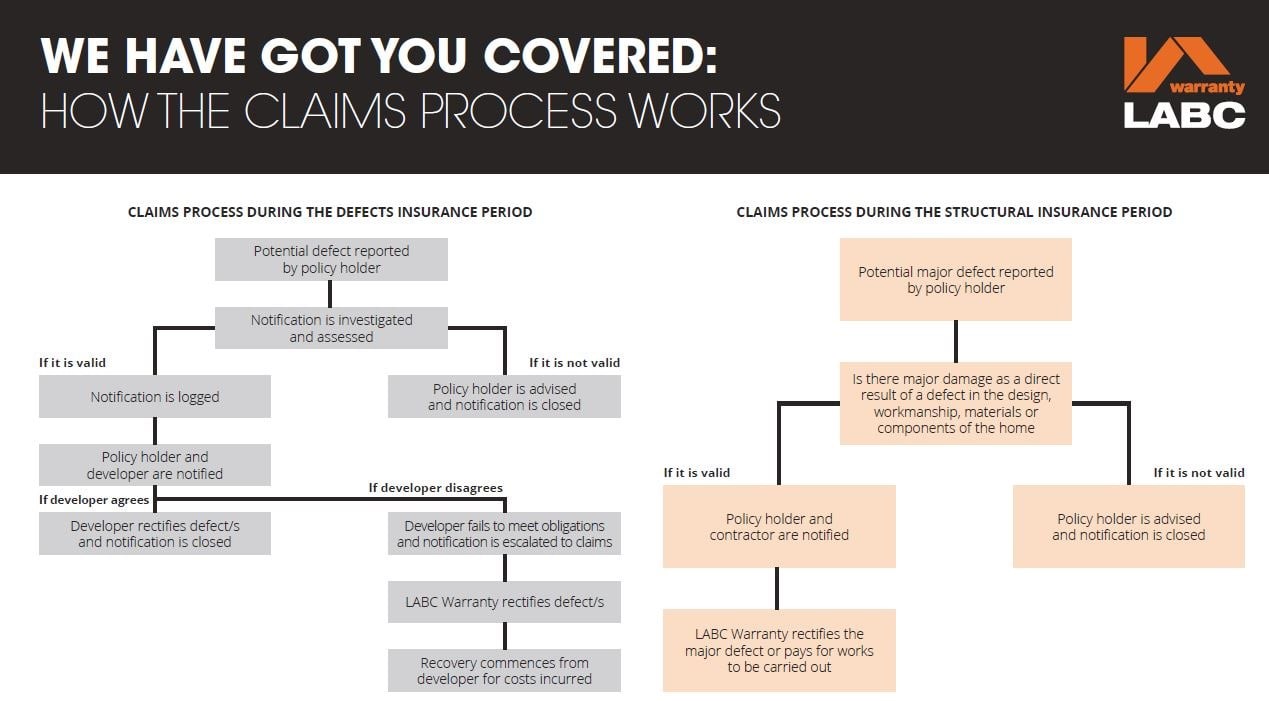
How the claims process works

You can read more about the claims process here, but the image below shows you how the process works depending on whether your property is in the Structural Insurance Period (SIP) or the Defects Insurance Period (DIP).


claims process


This information is provided for general information, and we recommend that you obtain a copy of the specific policy that affects your property so that you can be fully abreast of what your rights and obligations are under your warranty.